
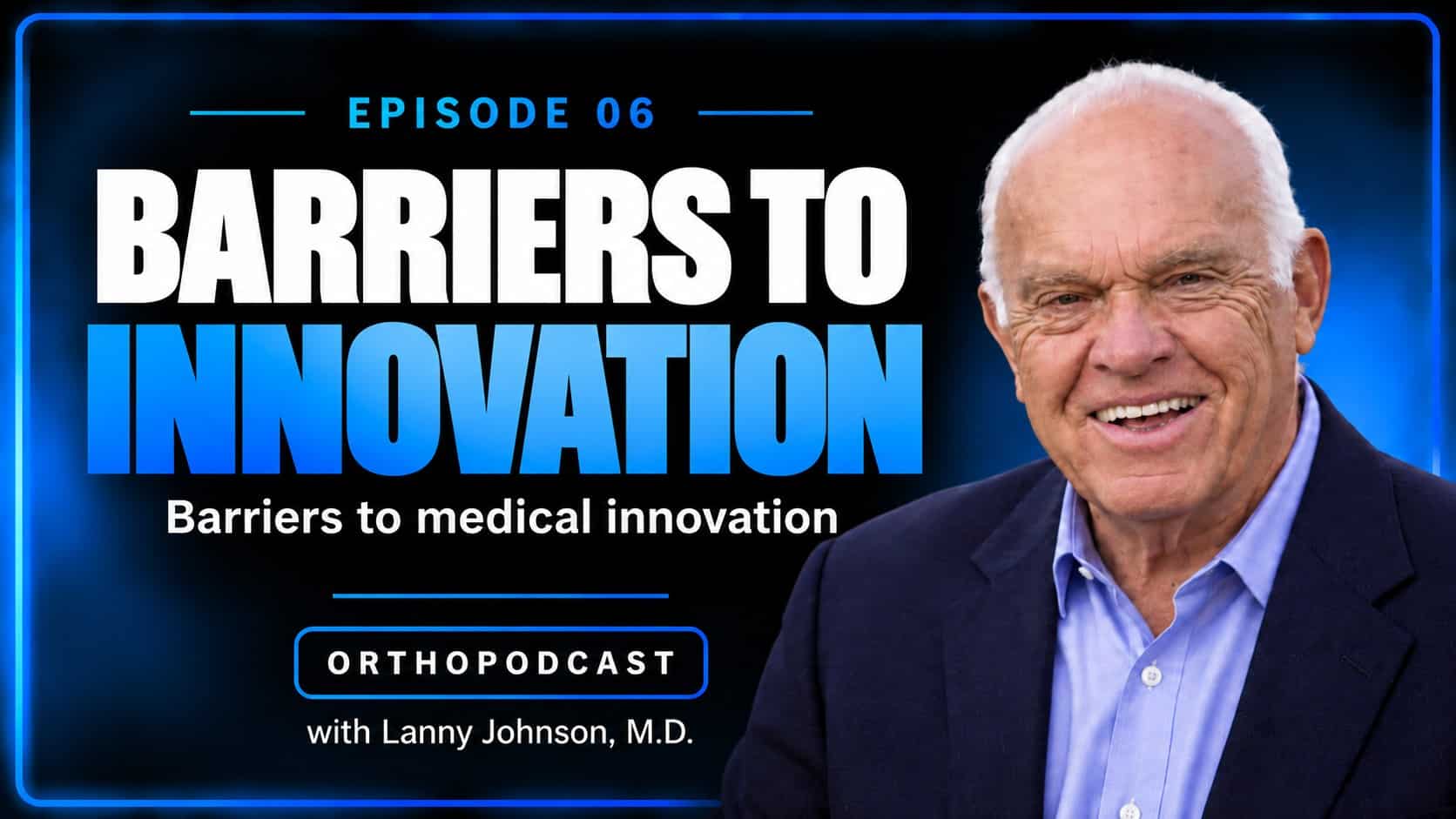
Medical innovation can fail long before anyone establishes whether an idea works. A physician may develop a diagnostic tool, test a surgical technique, or propose a payment model that appears to solve a real problem, yet still struggle to get it adopted. The barriers to medical innovation often extend beyond clinical evidence to include reimbursement, physician autonomy, regulation, commercial incentives, and resistance to unfamiliar ideas.
In his presentation, Lanny Johnson, M.D. draws on his experience in orthopedic surgery, medical software, reimbursement models, and product development to examine why promising ideas can stall. His examples raise a practical question for physicians and innovators: what does it take to move an idea from a working concept into routine use?
Why clinical evidence may not be enough
A medical innovation needs evidence, but evidence alone does not guarantee adoption. The idea must also fit the needs and incentives of the people expected to use, approve, fund, or commercialize it.
Johnson describes developing an electronic medical record system beginning in 1980 and completing it in 1982. He also describes creating a data-driven diagnostic questionnaire in 1990, built around approximately 4,500 knee cases and tens of thousands of data points. He says the questionnaire achieved about 80% diagnostic reliability when compared with operative findings.
Those figures are claims from Johnson’s presentation, not independently verified performance results. His broader point is about timing and acceptance. He says the diagnostic system was rejected because it arrived too early and was perceived as a potential substitute for physicians or a tool for surveillance.
That reaction illustrates a problem that can arise when an innovation changes how professional judgment is recorded or evaluated. A tool intended to support diagnosis may be interpreted as a threat to the person making the diagnosis. The response can depend as much on how the tool affects clinical roles as on what the tool does.
For innovators, this creates a distinction between technical performance and practical adoption. A system may function as intended but still fail to gain support if clinicians do not understand its purpose, distrust how its data will be used, or believe it could diminish their authority.
Before investing further in development, innovators should ask:
- What clinical problem does the tool address?
- What evidence supports its intended use?
- How does it affect the physician’s existing workflow and judgment?
- Who might see the innovation as a threat, and why?
- What would make the people expected to use it trust the results?
These questions do not replace testing. They help identify barriers that technical testing alone cannot resolve.
Physician autonomy and reimbursement can shape adoption
Johnson’s concerns extend beyond technology to the organization of medical practice. He describes orthopedic surgeons as well-paid employees performing piecework, often with responsibility for outcomes but limited authority over the systems in which they work. He characterizes this as “responsibility without authority.”
The distinction matters when physicians are expected to adopt a new process but have little control over how it is implemented or reimbursed. An innovation can require a clinician to change established practice, assume additional work, or accept new performance measures. If the financial and operational decisions sit elsewhere, the physician may have limited influence over whether the change makes sense.
Johnson also argues that conventional reimbursement language can obscure the value of a physician’s knowledge, skill, judgment, services, and availability. When payment discussions focus narrowly on billable activities, it can become harder to recognize the work involved in clinical assessment and decision-making.
His example of an early bundled payment arrangement illustrates the issue. Johnson describes working with a health maintenance organization on a physician-directed model involving 100 cases. He says the physician and hospital earned more while the insurer saved thousands of dollars. In his account, the model worked because physicians had a meaningful role in directing care and its associated costs.
He contrasts that experience with contemporary bundled payment arrangements that he says are controlled by insurers rather than physicians. The presentation does not provide enough detail to assess the financial results independently or to generalize from the example to all bundled payment programs.
The underlying question is still relevant to innovation planning: who controls the decisions, and who benefits if the innovation succeeds?
A reimbursement model can influence whether a clinical idea is financially sustainable. If the party paying for a service receives the savings while the party implementing the change absorbs the additional work, adoption may be difficult. If clinicians have no authority over the process, they may also have little ability to correct problems as they emerge.
For innovators, a practical starting point is to map the incentives before implementation. Identify who pays, who delivers care, who assumes the workload, who controls the process, and who benefits from improved results. Any mismatch deserves attention before the innovation is scaled.
Established surgical practices can resist change
Orthopedic surgery provides several examples in Johnson’s presentation of how established clinical practices can persist even as physicians explore alternatives.
He discusses the historical use of total meniscectomy, in which the meniscus is removed, and contrasts it with approaches involving meniscus repair or minimal resection. He also describes questions surrounding drilling for exposed bone in the setting of arthritis, assumptions about cartilage and fibrocartilage, and his work involving cancellous bone grafts for articular defects.
Johnson says he conducted work with 20-year follow-up on cancellous bone grafting for articular defects but did not see the approach commercialized. His presentation does not supply the underlying study, patient details, or comparative outcomes, so the claim should be understood as his account of the work and its subsequent adoption.
These examples point to several different reasons a surgical idea might not become standard practice. A new technique may challenge familiar training, require changes to established procedures, lack a clear path to commercial development, or struggle to gain the support needed for broader evaluation. A technique may also fail to spread because the available evidence does not persuade clinicians that it should replace current practice.
Those possibilities should not be treated as interchangeable. Resistance to change is not proof that an innovation is better, just as continued use of a familiar technique is not proof that it is best. Clinical decisions require evidence appropriate to the procedure, the patient, and the intended outcome.
The lesson is to examine both the evidence and the conditions surrounding adoption. Innovators need to be clear about what a new technique changes, what outcomes have been measured, what remains uncertain, and what additional work would help clinicians judge its value.
They also need to distinguish between two questions:
- Does the idea work? This requires appropriate testing and evidence.
- Can the idea be adopted? This requires understanding training, workflow, resources, clinical norms, and the path to implementation.
Answering one question does not automatically answer the other.
Regulation, funding, and commercialization create separate hurdles
A medical innovation can have a plausible clinical use and still face a long path to adoption. Development may require funding, collaborators, regulatory review, a route to reimbursement, and a commercial partner willing to support the work.
Johnson describes these as interconnected barriers. He points to regulatory processes involving bodies such as the FDA, as well as institutional review and environmental requirements where applicable. He also discusses the need for reimbursement codes, investment, partners, and a recognized market need.
The requirements depend on the nature of the innovation. A new surgical technique, a diagnostic system, and a medical device do not necessarily follow the same development path. The point is not that regulation or review should be bypassed. It is that innovators need to identify the relevant requirements early enough to plan for them.
Funding introduces another difficulty. Johnson argues that an idea can struggle to progress when the commercial return is uncertain or too distant. A company may be unwilling to invest in a product if it cannot see a viable market, even when the inventor believes the product could be useful.
That creates a gap between potential clinical value and commercial viability. The inventor may focus on what the technology can do, while a potential partner must also consider development costs, regulatory work, market demand, and the resources needed to bring the product to users.
Johnson mentions government-backed programs, including ARPA-H and BARDA, as possible sources of support for innovation. His presentation does not establish that any particular program will fund a specific project. Innovators would need to confirm eligibility, program priorities, and application requirements directly.
A practical commercialization plan should address the following before major resources are committed:
- Clinical need: What specific problem is the innovation intended to solve?
- Evidence: What has been tested, and what still needs to be demonstrated?
- Regulatory path: Which reviews or approvals may apply to this type of product or process?
- Reimbursement: How could the service or technology be paid for if it enters practice?
- Commercial support: Who has the capability and incentive to develop, distribute, or maintain it?
- Market adoption: What could prevent the intended users or institutions from accepting it?
A strong technical idea does not answer these questions by itself. Identifying the gaps early can help innovators decide whether to seek a partner, collect more evidence, revise the concept, or reconsider the route to market.
Commercial incentives and timing can determine what survives
Johnson’s examples outside medicine add another dimension to his argument. He describes developing golf-related inventions involving proprioception and tactile edge orientation. He says he tested the concepts with approximately 100 tour players, yet the products did not reach successful commercialization.
Those testing details are also claims from the presentation, not independently verified results. Johnson attributes the lack of uptake to factors including the approach used to introduce the products, a “not invented here” response, and the influence of established beliefs and habits.
The example matters because it separates an inventor’s confidence in a concept from the market’s willingness to adopt it. Testing may help establish whether an idea performs under particular conditions, but it does not by itself create demand, distribution, or commercial support.
Medical innovation faces a similar distinction, with additional clinical and regulatory considerations. The person who develops an idea may not be the person who controls the budget, selects the product, manages implementation, or bears the risk. Each of those stakeholders may evaluate the proposal differently.
Timing can also matter. Johnson’s early electronic medical record and diagnostic questionnaire examples suggest that an idea can arrive before its intended users are ready to accept it. But timing should not become a catch-all explanation for failure. A product may be rejected because the need is unclear, the evidence is insufficient, the implementation is difficult, or the commercial case is weak.
The task is to find out which barrier is actually operating.
Innovators can improve their assessment by talking with intended users and potential partners before committing to a full launch. Ask what problem they recognize, what evidence would change their minds, what practical objections they have, and what conditions would make adoption feasible. Their answers may reveal that the concept needs better evidence, a different introduction, a revised business model, or a more suitable partner.
What innovators can do to move an idea forward
Johnson’s experiences suggest that medical innovation requires more than developing a promising concept. Innovators must also understand the clinical environment, the incentives surrounding adoption, and the practical steps between development and use.
The following actions translate those lessons into an initial plan. They are planning suggestions based on the barriers discussed in the presentation, not a guarantee that an innovation will succeed.
- Define the problem precisely. State the clinical or operational problem, who experiences it, and what the innovation is intended to change. Avoid relying on enthusiasm for the technology as a substitute for a clear need.
- Separate evidence from assumptions. Document what has actually been tested, what the results show, and what remains unproven. Attribute performance claims accurately and identify the next evidence needed.
- Involve clinicians early. Ask intended users to assess the proposed workflow, clinical role, and practical limitations. Find out whether they view the innovation as a support for their work or a threat to their autonomy.
- Map the financial incentives. Determine who pays, who does the additional work, who controls implementation, and who receives the benefits. Investigate reimbursement requirements rather than assuming that clinical usefulness will create a payment pathway.
- Identify the regulatory and institutional requirements. Determine which reviews, approvals, or other obligations may apply to the specific innovation. Build those requirements into the development plan.
- Find partners who can advance the work. Consider which capabilities are missing, whether clinical collaborators or commercial partners can supply them, and what each party needs to justify involvement.
- Test the adoption case as well as the concept. Ask potential users and decision-makers what would prevent them from adopting the innovation. Use their responses to refine the evidence plan, implementation approach, and route to market.
Innovation remains uncertain even when these steps are followed. Some ideas will not prove useful. Others may work but lack a viable route to adoption. The objective is to understand the difference early, so decisions about further development rest on evidence and realistic constraints rather than optimism alone.
Frequently asked questions
Why do promising medical innovations fail?
A promising medical innovation may fail to reach routine practice because of limited evidence, poor fit with clinical workflows, reimbursement barriers, regulatory requirements, lack of funding or partners, or weak market demand. The reasons differ by innovation, so the first step is to identify the actual barrier rather than assume the technology itself is the problem.
Does clinical evidence guarantee that a new medical technology will be adopted?
No. Evidence can help establish whether an innovation performs as intended, but adoption also depends on whether clinicians and institutions can use it, whether its value is understood, and whether the financial and operational conditions support implementation.
How does physician autonomy affect medical innovation?
Physician autonomy can affect how clinicians evaluate and adopt new processes. If physicians are responsible for care but have little authority over implementation, reimbursement, or workflow, they may have limited ability to support or improve an innovation. Johnson identifies this tension as a recurring concern in his presentation.
Why can reimbursement prevent a medical innovation from reaching patients?
Reimbursement can influence whether a new service or technology is financially sustainable. If payment arrangements do not account for the work required or the benefits created, the parties responsible for implementation may have little incentive or capacity to adopt it. The relevant payment pathway depends on the innovation and its setting.
What should an inventor do before seeking a medical device partner?
An inventor should define the intended clinical need, document existing evidence, identify what remains to be tested, investigate relevant regulatory requirements, and understand the potential route to payment and adoption. A prospective partner also needs a clear explanation of the capabilities, funding, and commercial support the project requires.
How can an innovator distinguish resistance to change from a legitimate clinical concern?
Ask what specific concern is preventing adoption and what evidence would address it. A concern about workflow, training, or implementation differs from a concern about clinical performance. Both deserve investigation. Rejection alone does not show that an idea is ineffective, but it also does not establish that the idea is sound.
Can government programs help fund medical innovation?
Government-backed programs may provide support for eligible projects, depending on their goals and funding criteria. Johnson mentions ARPA-H and BARDA in his presentation. Innovators should check each program’s current priorities, eligibility rules, and application requirements rather than assume that a particular project qualifies.
When should a medical innovation be reconsidered rather than pursued?
An innovator should reassess the project when testing does not support the intended use, the clinical need is unclear, required evidence cannot be obtained, or a viable path to implementation cannot be identified. Reassessment may lead to a revised concept, further research, a different partner, or a decision to stop.
What to do next
The barriers to medical innovation are not all technical. As Johnson’s examples illustrate, an idea may encounter resistance because of professional roles, payment arrangements, established practices, regulation, funding, or commercial priorities.
For physicians and innovators considering a new idea, the next steps are concrete:
- Write down the problem and the intended clinical value.
- Establish what the available evidence does and does not show.
- Ask intended users about workflow, trust, and adoption concerns.
- Map the reimbursement and regulatory questions that apply.
- Identify the partners and resources needed to progress.
- Test the commercial and implementation assumptions before scaling.
Johnson closes his presentation with two statements: “Nothing profits like innovation. Nothing sells like integrity.” The challenge is to pair the drive to develop new ideas with honest evidence, a clear understanding of the barriers, and a realistic plan for putting the work into practice.